0%

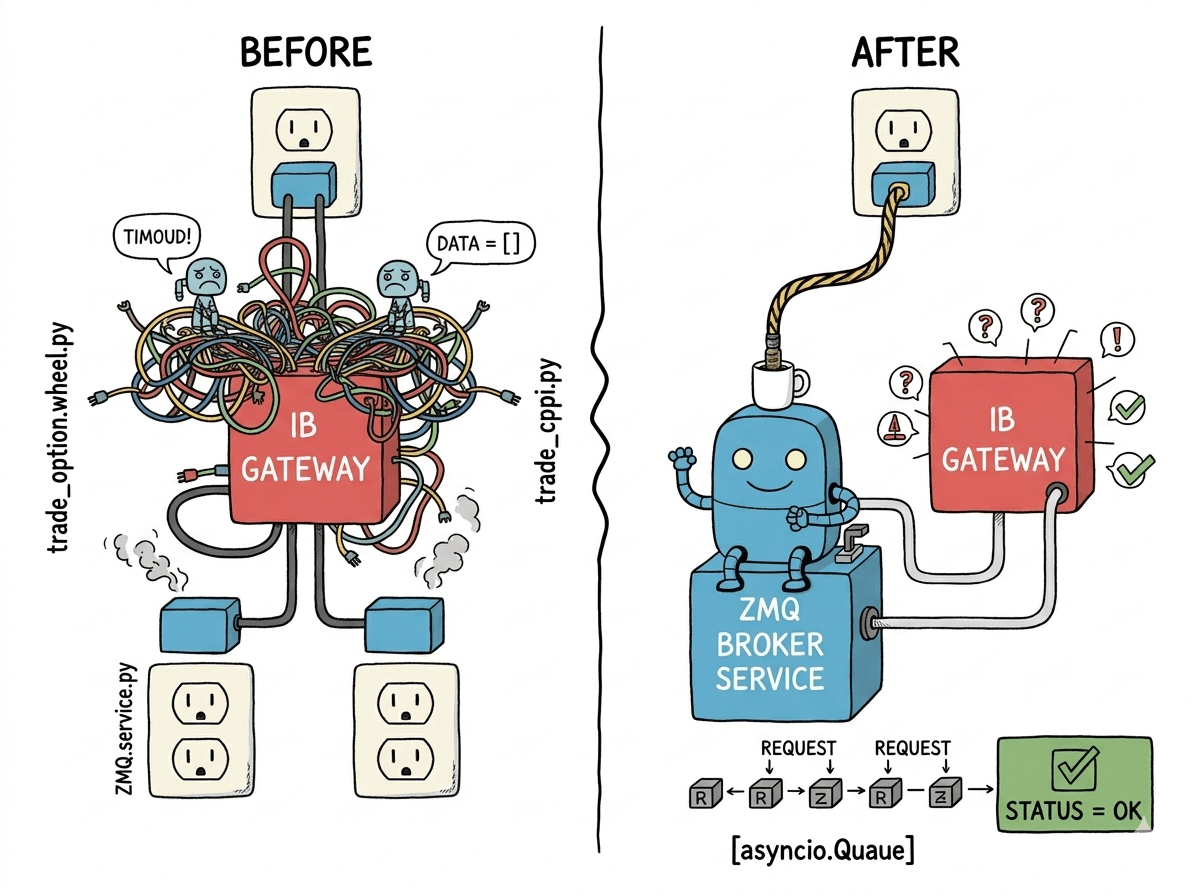
Photo by Gemini, Two trading scripts. One IB Gateway. Constant timeouts.

Picture two people trying to call the same phone number at the same time. One gets through. The other gets a busy signal — or worse, connects but hears nothing. Neither knows what the other is doing. Neither knows there is another person.

Running multiple trading strategies through a single IBKR TWS or IB Gateway is almost exactly this. The platform wasn’t designed for concurrent connections — it’s a trading terminal, not a message router. When two strategies fire at the same time, one gets data and one gets silence, and the logs rarely tell you which is which.

I’d been sitting on the fix for a while: a message queue in the middle, one process owning the IB connection, everything else talking to it. The architecture was clear in my head. I just didn’t have the time to build it solo. Now, since the AI coding capability improves drastically, I finally decided to open the Claude Code and said: “I have an idea. Help me build it.

This is what building with AI actually feels like.

Read more »

Extracted from Website: SteadyOptions

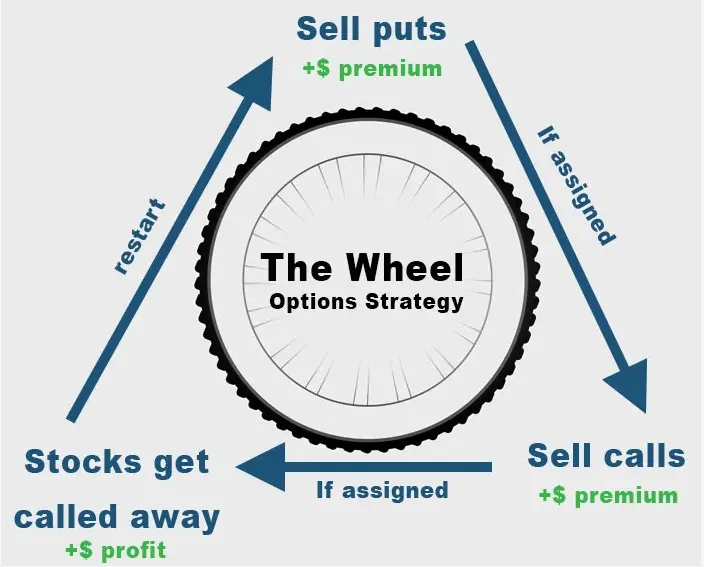
Stock option has always been a popular way to trade due to its high leverage, which allows traders to control a large amount of assets with a small amount of capital. However, the complexity of stock options can be overwhelming for many traders. For those who are the beginners of the stock option, today we’re going to introduce a simple trading strategy that can help you to get started with stock options trading without much effort.

Read more »

Cover image created through Copilot

Calculating the arithmetic mean and the variance (or the standard deviation) of a dataset is a fundamental task in statistics. These calculations provide valuable insights into the central tendency and distribution of the data in the linear space. However, it’s going to be a resource-intensive operation if you do these calculations repeatedly, especially when dealing with large datasets. To save you time and the memory on your computer, we’re going to explore an incremental approach to calculate the arithmetic mean and the variance (or the standard deviation) of a dataset.

Read more »

Cover image created through Copilot

Traditional grid trading systems, despite their popularity, face critical limitations with static price levels and poor performance in trending markets. Also, the vulnerability to sudden market gaps and the inability to adapt to changing market volatility is another huge obstacle. Given the promising and speedy advance in both hard and software of machine learning, Francesco Rundo, *Francesca Trenta, Agatino Luigi di Stallo, and Sebastiano Battiato* in the article Grid Trading System Robot (GTSbot): A Novel Mathematical Algorithm for Trading FX Market proposed a new type of Grid Trading System that solves the challenges of the traditional one. This system dynamically optimizes entry/exit points and adapts to market conditions in real-time, maximizing profit potential while managing risks. Join me as I break down the complete process, from data preparation to model training, and reveal how you can implement this advanced trading strategy yourself.

Read more »

Cover image created through Copilot

Have you ever struggled to understand Bayes’ Theorem? You’re not alone. I used to find the formal definitions and explanations of Bayes’ Theorem on Wikipedia confusing and hard to grasp. But after revisiting the basics of Venn Diagrams, everything suddenly became clear! Let me break down the complex formula into easy-to-digest parts using color coding and visual aids with Venn diagrams. Let’s dive in!

Read more »

Cover image created through Copilot

Ever wondered how to tell if the market is roaring like a bull or growling like a bear? This article will dive deep into how these indicators perform in different market conditions, comparing manual identification with indicator-based methods. By adding this market indicator, you’ll see how momentum strategies shine in bull markets, while mean reversion and pair trading strategies come into play during bear markets. Plus, we’ll uncover some insights that you might never have considered while applying market indicators in your own algorithm trading script. Now, let’s dive in and uncover the secrets of the market together!

Read more »

Cover image created through Copilot

Feature engineering is a make-or-break step in the machine learning pipeline, but even seasoned practitioners can fall victim to a subtle yet devastating mistake. While labeling or transforming data may seem like a straightforward task, a common pitfall lurks in the shadows, waiting to undermine your model’s performance in ways you might not expect. This often overlooked issue can lead to a phenomenon known as “look-ahead bias,” where your model inadvertently gains access to information it shouldn’t have during training. In this post, we’re going to talk about what this pitfall exactly is and how to address it.

Read more »

Cover image created through Copilot

Testing APIs with OAuth 2.0 authentication can be a complex task, but Postman simplifies the process by providing built-in support for various OAuth 2.0 flows. Postman seamlessly complements OAuth 2.0 authentication, allowing developers to easily configure settings, obtain access tokens, and manage token lifecycle. In this post, we will quickly go through this process by utilizing the Postman software.

Read more »

Cover image created through Copilot

In my previous How2 column Connecting My Trading Strategies To Interactive Brokers, I shared how to set up the Interactive Brokers API connection through the Trader Workstation (TWS) on the local machine. However, the enforced rules like daily auto restart and weekly log-out can be a hassle if you are away from your local machine for many days. In this article, we’ll leverage the power of docker to free you from managing your locally-run TWS attentively.

Read more »